
Very little has happened in F1 over the Christmas period; perhaps only the continuing speculation regarding the Force India drive being of any real interest to the fans. Giancarlo Fisichella has been confirmed and unconfirmed as Vijay Mallya's choice almost as often as turkey has appeared on the menu during the festive season, but it is most likely that the choice has not been made yet. A seemingly unrelated snippet of news had me pondering, however. Jos Verstappen will be driving in the Le Mans 24 hour race, apparently.
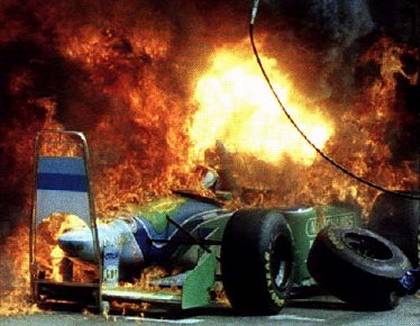
Jos Verstappen's moment of fame, 1994
So what is the connection between Jos and Fizzy? They both have or had Flavio Briatore as their manager and, in my opinion, he did neither of them any favors. Jos, especially, was directed into a long string of uncompetitive teams where it was almost impossible for him to show his talent.
Like Raikkonen, Jos arrived in F1 with a very short history in single seat racers - just two years, first in Opel Lotus and then in German F3, had seen him win two championships and emerge as an unusually gifted driver with tremendous potential for F1. He was snapped up by Benetton as their test driver for 1994 and there he began his relationship with the Flav. The number two at Benetton, JJ Lehto, promptly put himself out for the season by breaking a neck vertebra and Jos went straight into the race car.
That first year demonstrated the bad luck that was to be Verstappen's main claim to fame in F1. In his first race, he was tipped into a spectacular crash by the inevitable Eddie Irvine, emerging unscathed; then, in the German GP, his car burst into flame during a pit stop, Jos escaping with minor burns to his nose. It was not an auspicious debut but to be expected when it is remembered how quickly Jos had arrived in F1.
Flavio then made one of those decisions that seemed crazy at the time and proved even worse - he put Jos into the Simtek team for 1995, the year they went bust. And that proved to be the pointer for the rest of Verstappen's F1 career - he went from one collapsing team to another, never getting a chance in a decent car. The list is like a record of all the failures of the past decade: Simtek, Footwork, Tyrrell, Stewart, Honda's aborted 2000 attempt to form their own team, Arrows and finally Minardi.
With a series of such teams, there was little chance for Jos to shine but, even so, he managed it on occasion; have a look at this highlights video of the 2001 Malaysian GP. It is very noticeable too that wet races gave him the chance to show his ability, the car's shortcomings negated to some extent by the conditions.
And, in that, there is a similarity to Fisichella's career. Although not as obviously as with Jos, rain has often been the opportunity for Fizzy to haul an uncompetitive car up amongst the leaders.
Giancarlo began as Jos finished: in a Minardi. In 1997, he was given a drive by the Jordan team and rewarded them with some great performances, confirming the promise that we had all noticed. It would have made sense for him to continue with Jordan but, at this point, Flavio intervened, bringing him into the Benetton team so recently deserted by Michael Schumacher.
I felt it was a bad move at the time and so it proved. Benetton had lost their works Renault engines and the car's performance suffered accordingly. Fizzy did his best and scored on several occasions but it was an uphill battle. After four years of struggle with the Benettons at a low ebb, he went back to Jordan.
Rarely have there been such perfectly timed bad moves in F1. Benetton were about to rise again, ultimately as a reborn Renault team, and Jordan were on the slippery slope to oblivion. For two more years Fisichella's talents were wasted in the attempt to get a poor car into the points and it is a measure of his ability that often he succeeded. More of the same followed in 2004 when he joined Sauber.
Finally, Flavio took him back into Benetton/Renault, just in time for him to be compared with the rising star of Fernando Alonso's talent. And Giancarlo's luck made sure that it was an uneven contest - after a victory in the first race of the 2005 season, Fizzy suffered a series of retirements that put him behind Alonso in the table, thereby ensuring that the team's major effort went into Alonso. It was a bitter blow to have a good car at last, only to be beaten by a young charger and bad fortune in the end. Now Fizzy stands in line at Force India, hoping for one more chance to stay in F1, a talent once bright with hope now dimmed by the passing years.
And I blame Flavio. His influence on the careers of these two drivers has been unhelpful, to say the least. At times they had chances that would have seen them in competitive cars early in their careers, when their talent was still growing and they were stars in the way that Hamilton is now. Instead, they were guided into teams that were on the way out, there to feed off the scraps of occasional and fleeting success. It is no wonder that the stuffing was beaten out of them in the end and they became better respected for their setting up skills than their racing.
Briatore is all very well when things are going well; when fortune turns against you, he is not the man you want negotiating your contracts. If I were a driver, I think he would be the last manager I'd want.
Jos Verstappen's moment of fame, 1994
So what is the connection between Jos and Fizzy? They both have or had Flavio Briatore as their manager and, in my opinion, he did neither of them any favors. Jos, especially, was directed into a long string of uncompetitive teams where it was almost impossible for him to show his talent.
Like Raikkonen, Jos arrived in F1 with a very short history in single seat racers - just two years, first in Opel Lotus and then in German F3, had seen him win two championships and emerge as an unusually gifted driver with tremendous potential for F1. He was snapped up by Benetton as their test driver for 1994 and there he began his relationship with the Flav. The number two at Benetton, JJ Lehto, promptly put himself out for the season by breaking a neck vertebra and Jos went straight into the race car.
That first year demonstrated the bad luck that was to be Verstappen's main claim to fame in F1. In his first race, he was tipped into a spectacular crash by the inevitable Eddie Irvine, emerging unscathed; then, in the German GP, his car burst into flame during a pit stop, Jos escaping with minor burns to his nose. It was not an auspicious debut but to be expected when it is remembered how quickly Jos had arrived in F1.
Flavio then made one of those decisions that seemed crazy at the time and proved even worse - he put Jos into the Simtek team for 1995, the year they went bust. And that proved to be the pointer for the rest of Verstappen's F1 career - he went from one collapsing team to another, never getting a chance in a decent car. The list is like a record of all the failures of the past decade: Simtek, Footwork, Tyrrell, Stewart, Honda's aborted 2000 attempt to form their own team, Arrows and finally Minardi.
With a series of such teams, there was little chance for Jos to shine but, even so, he managed it on occasion; have a look at this highlights video of the 2001 Malaysian GP. It is very noticeable too that wet races gave him the chance to show his ability, the car's shortcomings negated to some extent by the conditions.
And, in that, there is a similarity to Fisichella's career. Although not as obviously as with Jos, rain has often been the opportunity for Fizzy to haul an uncompetitive car up amongst the leaders.
Giancarlo began as Jos finished: in a Minardi. In 1997, he was given a drive by the Jordan team and rewarded them with some great performances, confirming the promise that we had all noticed. It would have made sense for him to continue with Jordan but, at this point, Flavio intervened, bringing him into the Benetton team so recently deserted by Michael Schumacher.
I felt it was a bad move at the time and so it proved. Benetton had lost their works Renault engines and the car's performance suffered accordingly. Fizzy did his best and scored on several occasions but it was an uphill battle. After four years of struggle with the Benettons at a low ebb, he went back to Jordan.
Rarely have there been such perfectly timed bad moves in F1. Benetton were about to rise again, ultimately as a reborn Renault team, and Jordan were on the slippery slope to oblivion. For two more years Fisichella's talents were wasted in the attempt to get a poor car into the points and it is a measure of his ability that often he succeeded. More of the same followed in 2004 when he joined Sauber.
Finally, Flavio took him back into Benetton/Renault, just in time for him to be compared with the rising star of Fernando Alonso's talent. And Giancarlo's luck made sure that it was an uneven contest - after a victory in the first race of the 2005 season, Fizzy suffered a series of retirements that put him behind Alonso in the table, thereby ensuring that the team's major effort went into Alonso. It was a bitter blow to have a good car at last, only to be beaten by a young charger and bad fortune in the end. Now Fizzy stands in line at Force India, hoping for one more chance to stay in F1, a talent once bright with hope now dimmed by the passing years.
And I blame Flavio. His influence on the careers of these two drivers has been unhelpful, to say the least. At times they had chances that would have seen them in competitive cars early in their careers, when their talent was still growing and they were stars in the way that Hamilton is now. Instead, they were guided into teams that were on the way out, there to feed off the scraps of occasional and fleeting success. It is no wonder that the stuffing was beaten out of them in the end and they became better respected for their setting up skills than their racing.
Briatore is all very well when things are going well; when fortune turns against you, he is not the man you want negotiating your contracts. If I were a driver, I think he would be the last manager I'd want.