
It is all about money, isn't it? A revealing article in the Guardian newspaper draws back the covers on the network of vested interests and deals behind the show business face of F1. And it turns out that the drive towards standardizing the cars as part of the FIA's cost-cutting exercise may have much more to do with the loan burden on the sport than has been apparent.
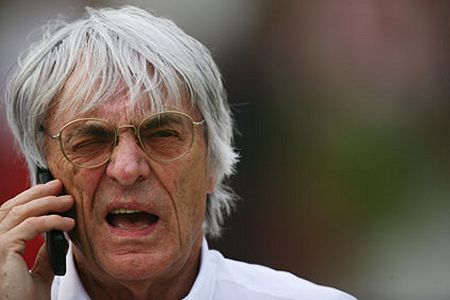
Bernie Ecclestone
It is no secret that the commercial rights holders, CVC Capital, financed its purchase through loans that now require huge amounts in interest payments. This demands that the number of GPs be increased to Bernie's present maximum of twenty, even though the total has fallen to seventeen in 2009, thanks to the demise of the Canadian and French GPs. Any decrease in the number of races means a lowering of income for the sport and so the pressure is on Bernie to keep selling GPs to countries that can afford to pay his exorbitant price.
But the teams have begun to suspect that the FIA's cost-cutting drive has more to do with maximizing CVC's share of profits, rather than any real concern for the good of the sport and they want to re-negotiate their portion of profits. Their resistance to the FIA's proposals increases, therefore, as everyone shouts for a bigger piece of the F1 pie.
I do not pretend to understand the complex arrangements that bring this situation about but can see that it makes questionable one of the great myths of the sport - that Bernie has done such a wonderful job of expanding F1 and bringing huge amounts of money into it. There is no doubt that more money is spent in F1 than ever before but, when it is realized that this is underpinned by debts requiring vast sums merely to meet interest payments, the wisdom of selling the soul of the sport becomes less evident.
It seems that Bernie has made himself and a few others in the sport rich by designing it as a money-making venture, rather than a genuine contest with a history and tradition reaching back more than a hundred years. In building the global reach of F1 to its present heights, Bernie has also sacrificed many of the links with the past that make the sport so watchable and dramatic. It does not matter that great circuits are disappearing off the calendar to be replaced with featureless tracks designed to a standard formula, he does not care that the element of competition is squeezed out by the ever-increasing strangulation of innovation by the rules - all is subject to the mighty dollar and whoever can pay the piper gets the contract.
Yet the whole thing now appears to be a house of cards ready to collapse in the next economic recession. Greed has dictated that the profits from the sport are not poured back into it but are used to fill the pockets of a few and service astronomical debts that were undertaken without thought for the future. It would be an interesting and salutory lesson to be enjoyed by spectators, were it not for the fact that it affects the sport we love. When regulations are forced upon the teams because CVC needs more money for interest payments, we are right to object. If the gamblers are caught out, why should the sport bail them out?
I do not have any answers to this complicated mess. The sport will have to lie in the bed that Max and Bernie have prepared for themselves and I can only hope that somehow the spirit of F1 will survive the coming storm and emerge as a creature still resembling the great contest it has been for so long. But let us stop all this nonsense about how great Bernie has been for F1 - the truth is he has put it into the hands of the money lenders and it is no longer the master of its own fate.
Motor racing has always captured the interest of the public. Nuvolari, Fangio and Moss were as much household names as are Schumacher, Alonso and Hamilton today. The people need heroes and F1 supplies them in abundance - yet where will they come from once the sport has been reduced to a business enterprise only? Bernie may have made himself indispensible but we should not thank him for what he has done to the sport. History may well have a harsher view of him than we suspect.