
It seems that Ferrari are a bit annoyed that word of their now-famous "hole in the nose" of the F2008 leaked months ago. The first news of the innovation appeared in the Italian magazine, Autosprint, in February, long before the idea was tried on the track, and apparently very few within the company knew about it at the time.
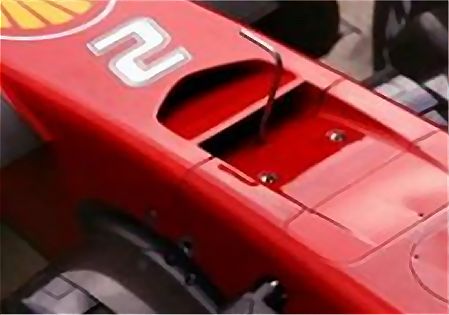
The Ferrari nose hole
That should help the team to identify the source of the leak but it also raises questions about the espionage saga of last year. Not much notice has been taken of Nigel Stepney's statements since he was sacked from the company but the possibility that he has been truthful all along now raises its unwanted head. He has said that he did not release anything like as much information as was claimed, insisting that there were others who were stealing from the company at the same time. That might well include the famous Ferrari dossier, Stepney having denied that he was responsible for its transmission to Mike Coughlan.
Ferrari has ignored the possibility of there being leaks beyond those caused by Stepney but now it seems that they are forced to reconsider. There is no way the "nose hole" leak can be blamed on the disgraced engineer. This brings home an aspect to the affair that was always glossed over by the FIA in its investigation - the fact that Ferrari security is a good deal less effective than it should be. In a sport where industrial espionage is a crime so serious as to be worth a $100 million fine, there is a responsibility on the originating company to guard its secrets effectively.
The plain fact is that security in Ferrari is a flexible thing anyway. The quantity of information that was leaked to the Italian press before and during the WMSC hearings made that very clear. Those leaks were probably intentional, designed as they were to stir up anger at McLaren, but they are also indicative of a company culture that sees the positioning of information as a useful tool in achieving its ends.
In such a culture, it is hardly surprising that leakages occur that are not beneficial to the team. Once employees have seen that the judicious release of information is acceptable in some cases, it is natural that they should include such methods in any scheme to benefit themselves. If Ferrari have been bitten by their own lack of interest in effective security, it is tempting to say that they have only received what they deserved.
As for the nose hole itself, it is unlikely to be the huge step forward that the Barcelona test times would seem to indicate. Massa's extremely quick lap was set on slick tires with 2008 downforce settings whereas McLaren's time on slicks was spent with 2009 low downforce settings.
The idea is not new, anyway. Patrick Head has mentioned that it is the same notion they were trying with the walrus nose Williams - they merely removed the upper bodywork over the channel of air from the front wing instead. Ferrari's solution may be a little more effective in that covering the channel enables the airflow to be better controlled but, as demonstrated by the Williams experiment, any advantage gained will be minor.
It is the same with many of the tweaks introduced by F1 teams over time. For instance, the wheel inserts brought in by Ferrari were slow to be copied by other teams mainly because the advantage they gave was minimal. One team that could afford to have such a tweak, BMW, still has not bothered with the idea (although you can bet they have tried it in the wind tunnel). That surely must indicate that the inserts work well enough on some cars to be worth the expense and effort of designing them, but are less effective on others.
The same is likey to be true of the nose hole, although it may concentrate the aerodynamicists' thoughts on that area. We might well be in for a period where several different solutions are tried, perhaps even a rebirth of the walrus nose!
And, talking of rebirth of ideas, the nose hole idea goes back much further than the Williams FW26 of 2004. The principle was first seen in F1 in the shape of Colin Chapman's design for the windshield of the Lotus 25 in the mid-sixties. It may, in fact, be the first attempt to shape the airflow rather than just to make the car as slippery as possible.
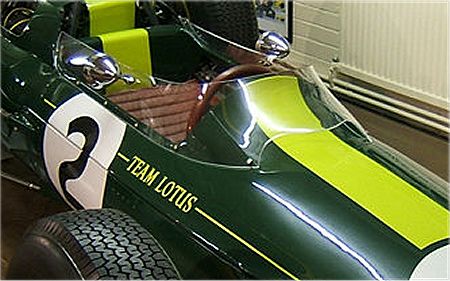
Lotus 25 windshield
There is nothing new under the sun, it seems. Not even intrigue and deception within Ferrari...