
I was glad that Lewis Hamilton won at Silverstone and in such dominant fashion; the chorus of Lewis-bashing had reached so ridiculous a crescendo that it became as irritating as the Hamilton worship of the tabloids that preceded it. Perhaps this win will even things out a bit and we can discuss the guy in more realistic terms in future.
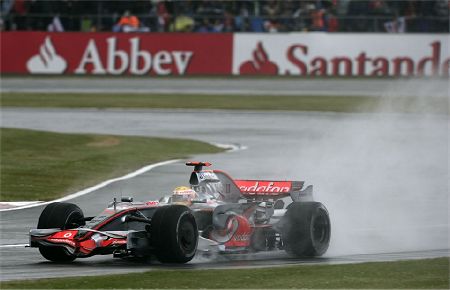
Lewis Hamilton
Contrary to some commentators, I do not feel that the margin of Hamilton's win was an unfair reflection of his superiority on the day. Ferrari maintain that they could have won, had they not made the wrong tire choice at Kimi's first stop, and it is true that Raikkonen would have been closer without that blunder. But that ignores the fact that Kimi was on the right tires after his second stop and still managed a couple of spins whilst nowhere near the consistent pace of Hamilton.
Both Ferrari and McLaren have made strategic errors this season and their drivers have paid for them. Of the two, it does seem that the Italian team go in for more inexplicable decisions and not changing Kimi's tires at the first stop seems to me one of these. If you're battling for the lead, you don't take chances on the weather, you go for the best compromise. That is what McLaren did and it paid off - but even if the rain had eased off as Ferrari expected, I doubt that Raikkonen's old tires would have been any better than Hamilton's new ones.
That is why I consider the decision to have been a blunder. And Raikkonen is driving for a team that makes a lot of these, perhaps trying to be as cunning as they were in Ross Brawn's day. If Ferrari ever decide to forget winning through tactics and just concentrate on giving their drivers the best car, the other teams will need to start worrying.
It does look as though Hamilton is the rainmeister of the current crop of drivers; as one of the commentators on American television said, he makes it look easy while everyone else (bar Mr Consistency, Nick Heidfeld) is spinning off. Before the race, everyone was talking about the wet weather skills of Button, Kubica and Raikkonen, but now Hamilton has proved himself in a class of his own. We can talk of how much easier it was for him when the heavy rain came and he had a huge lead, so being able to take things carefully. But that argument proves empty when we compare Hamilton's times with Barrichello's on extreme wets and Heidfeld's on inters. Rubens was four or five seconds quicker than Heidfeld at the time, Hamilton was very close to Rubens' times on most laps. If Hamilton was relaxing (and Whitmarsh says he was), just how fast could he have gone?
What it amounts to is that Hamilton will be the one to watch whenever we have a wet race. The car is certainly good enough to challenge Ferrari, even in the dry, but put Hamilton in it when it's raining and I think he will win nine times out of ten.
Martin Whitmarsh did say something else that caught my eye in the interview just mentioned. He spoke about new oil technology being employed to improve engine performance, thus reminding us of similar work being done by Renault and Elf earlier this year. It sounds like scraping the barrel but even the slightest improvement helps in F1 - and it is yet another demonstration that cost-cutting measures of the type that the FIA introduce do not work. I am quite sure that just as much money is being spent on lubricant research as would have been on engine development without the freeze.
It also shows that engineers will find ways to make the cars faster, whatever restrictions are placed upon them. If the FIA are seriously bent on making all the cars equal, they will have to take things to the logical extreme of a spec series. And none of us want that, surely.