
A few days ago, I watched the NASCAR Sprint Cup Daytona 500 on SpeedTV - yes, the whole thing plus hours of pre-race build up. It was an experience that had me thinking on all sorts of levels and, inevitably, the comparison with F1 was my primary interest. This is the series that is always held up to F1 as an example of how to do things differently, after all.
NASCAR
So many impressions and thoughts crossed my mind during the race that I may be even more confused than when I started. It was motor racing of a sort, I think, but so far removed from the F1 experience that I am not sure either sport has anything to learn from the other. The only similarity I can think of is that Daytona was like hours of continual slipstreaming along the old straight at Monza without cornering in between.
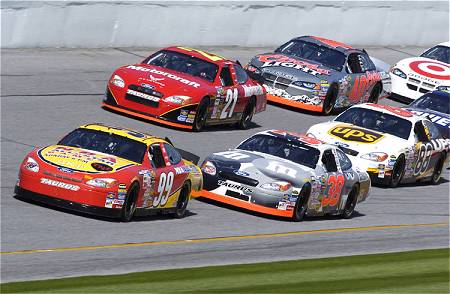
Back in the days when such things were possible at Monza, there might be five or six cars swapping places as they hurtled down the straight; it was stirring stuff and produced some of the closest finishes ever known in F1. But at Daytona, almost the entire field went round in a tightly-packed bunch, all slipstreaming each other and jostling for position from beginning to end. That means over thirty cars in a 200mph traffic jam - and that demands incredible bravery from the drivers.
It also means that the race becomes a lottery. It seemed to me that the quickest driver out there was Kyle Busch and he duly led the first thirty laps or so (no mean feat when your closest competitor is just inches away from your tail and has the benefit of the draft). Come the pit stops and safety car periods, however, he lost his lead and was rarely heard from again. Instead there was a series of leaders, determined mainly by luck in the timing of others' crashes and pit stops, and the winner was the guy (Matt Kenseth - no, I had never heard of him before either) who happened to be in the lead when rain stopped the race.
Obviously, the reason for my ignorance of Kenseth is that I have not followed NASCAR before (apparently, he was champion in 2003) but he is not one of the big names known to outsiders (Dale Earnhardt Jr., Jeff Gordon, Jimmie Johnson). This is reflected in the fact that none of the commentators even mentioned him when giving their predictions before the race. As an aside, one of them went for Mark Martin who qualified in second place - and is fifty years old...
I would guess that not all NASCAR races are as much of a lottery as this one was. The fact that there are star drivers who do most of the winning illustrates that there is more to it than just luck. But good fortune plays far more of a part than it does in F1 - get a bad pit stop in NASCAR and you're done.
This was particularly noticeable if you were following the ex-F1 drivers in the race. Scott Speed started from 35th place and spent the entire time gradually moving up the order (as high as 24th at one point), only to be knocked back down again by some incident or other. He finished 35th - small reward for many hours of fighting through the pack, although his prize money of $268,763 must have been some consolation (Kenseth gained $1,530,388). Suddenly it becomes clear why none of these drivers may ever be lured into F1!
Montoya's progress was even more yoyo-like than Speed's - starting 8th, he fell back initially, then climbed rapidly before incidents that buried him in the pack again. His final position of 14th would have been very different had the race been stopped on almost any other lap.
The net result of all this is that I have to re-think the usual criticisms of F1. The overwhelming cry from fans over the last few years has been for more overtaking but NASCAR shows that it is much more the type of overtaking that matters. In every lap of the Daytona 500 there was passing throughout the field, so much so that it became irrelevant and merely made the scrolling position list jump around a bit. F1's scarcity of overtaking maneuvers actually makes each one more valuable, more indicative of ability on the part of the driver, so that we can discuss a single passing move for weeks afterwards.
Another common criticism is that F1 is predictable and it is certainly true that, during the Schumacher years, a bet on Michael was almost certain to be rewarded. Yet I suspect that this is still better than any prediction being the wild guess that it must be in NASCAR. Things have improved in F1 anyway, the last couple of years being much harder to predict than previously. Try picking the champion for 2009 and the likelihood is that you'll be wrong.
And that leaves me with the TV coverage - something that NASCAR is said to get so much better. I have to say that I like the scrolling position list; it is much easier to follow a driver a few places down from the leaders with this constantly available feature. The driver's radio snippets were also more numerous (and more humorous) than F1's occasional forays into such territory. Other than that, however, I think F1 does as good a job in its telecasts.
NASCAR drivers are supposed to be more accessible to the fans and so they are - if you're at the circuit. On TV the driver coverage is thin, interviews being short and lacking depth. And having the drivers perform little antics for the cameras with added animations just seems to trivialize their skills and achievements. Interest in technical aspects of the cars is virtually nil, unsurprisingly considering how close they are in spec and performance.
All things considered, I have to conclude that the two forms of motor racing are so different that it is unfair to compare them to each other. It is like comparing F1 with rallying - different aims, different solutions and different appeals to the viewer. As an F1 fan, I am baffled by NASCAR racing but must shrug and say, "chacun à son goût" (each to his own).
Which reminds me - I found a Brit food site a while back and yesterday treated myself to a Marmite sandwich!