
Now that we have negotiated the political and legal furore of the last couple of days, we can look ahead to this weekend's Singapore GP. It is the second new circuit of the season, a street circuit and much anticipated as the first ever F1 race to be run at night. That is a lot of firsts and it would be easy to become enthusiastic about it were it not for the disappointment that was Valencia.
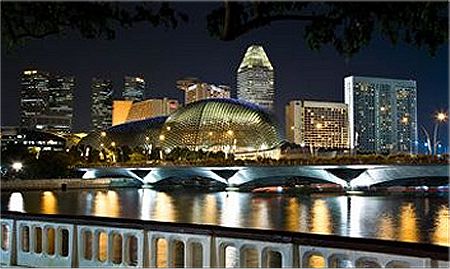
Singapore at night
I wrote two posts on the Valencia GP, one before and one after, and they were pretty optimistic. The truth was that, regardless of how future races at the circuit pan out, this year's was the sort of monotonous procession that F1 produces at its worst. Having proved totally wrong in my expectations of Valencia, I am now hesitant to get too excited about Singapore.
It does have a lot going for it in theory, however. The setting, as typified in the photograph above, is entirely more impressive than Valencia's dusty industrial backdrop. Its century-old Anderson Bridge, over which the cars will race, looks to be much more of a landmark than Valencia's ultimately nondescript bridge over the harbor turned out to be. The circuit is considerably tighter than Valencia's too, and is expected to be more akin to Monaco in that respect. Add to that the drama of a night race and it seems that we could be in for a treat.
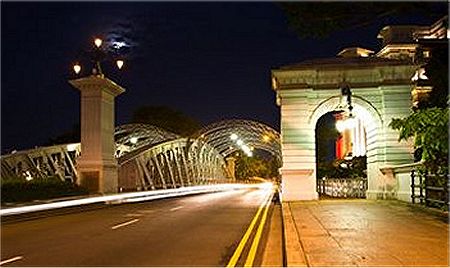
Anderson Bridge
My caution leads me to doubt that much of this will matter in the event, however. The city is undeniably spectacular once night has fallen, but how much of that will we actually see once the race has begun? It may be that the cars will be racing in a tube of light cast by the much-vaunted new lighting system and that any backdrop will be lost in the blackness beyond. And the circuit configuration becomes less interesting when we realize that it is almost totally devoid of gradient.
These two factors may seem irrelevant to the quality of the racing but they have an important part to play in our perception of any circuit. Would Spa be our perennial favorite were it surrounded by featureless desert rather than the forested hills that encompass it, supplying the atmosphere with that misty dampness that is always the threat of rain? Monaco, too, would be the ridiculously impractical circuit that it is sometimes accused of being, were it not for the aura of old time splendor provided by the Mediterranean architecture, the blue harbor studded with the bright, white yachts of the rich and famous, the steep gradients and familiar bumps known to such greats as Fangio, Moss and Clark.
To compare Singapore to Monaco is hoping for a lot, therefore. It may be similar in configuration but its character is modern and bustling with international commerce, in contrast to the old world grandeur of the Principality. This would be its claim to fame, if the skyscraper setting is able to defeat the brightness of the circuit lighting.
The lack of gradient is worrying, too. Steep inclines make all the difference in endearing a circuit to racer and fan alike, as evidenced by the Corkscrew at Laguna Seca, a circuit unremarkable for its setting but beloved by all for that one fabulous, swooping dive down a sudden and unexpected cliff. Without a distinguishing feature such as this, Singapore must hope that its night-time setting will provide the drama and interest of a classic race.
Feeling amongst the drivers themselves is mixed, some hoping for a considerably more eventful race than we saw at Valencia, others suggesting that it will be yet another procession. We must hope that the optimists are right this time, for the sport hardly needs another circuit that discourages overtaking and close competition. Singapore has a tall order to meet, I think.
Of course, if it rains, all bets are off; that will confound all my speculation and we will find out how the combination of bright lights and spray can turn a race into a lottery.