
There has been endless argument over McLaren's equal treatment for drivers policy, some disbelieving it entirely, others pointing out that perfect equality is impossible, yet others considering it inferior to the practice of having a stated number one. And now Pedro de la Rosa has aired views that seem in conflict with his employer's policy.
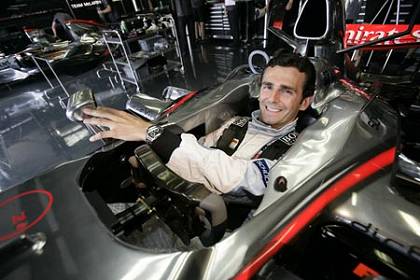
Pedro de la Rosa
Several things strike me about this. As Keith Collantine has pointed out in F1 Fanatic, Pedro's statements certainly indicate that the equal opportunity program is McLaren's way - or there would be no point in his disagreeing with it. Keith goes on to wonder whether this is a sign that de la Rosa is soon to leave McLaren, while at least one commenter sees it as a public relations exercise allowing Pedro to remain on good terms with both McLaren and his Spanish supporters.
There are indications that de la Rosa is getting restive, his recent mention of his desire to get back to racing rather than testing being a sure sign. But I would have thought that, if he had genuinely given up on the idea of ever gaining a race seat in F1, he would have just resigned. It seems a bit unnecessary to have to invite termination by making contrary statements to the press.
In fact, the likelihood is that we read far too much into any statement in F1 these days and Pedro was just being honest, without thought of the fallout he might cause. He has a fine line to walk between the opposing forces of employer and fans, after all, so anything he says is bound to be over-analyzed.
Even so, it is an odd thing to say in the circumstances. More than anything else, it reminds me of Nigel Stepney's admission to Autosport in late 2006 that he was dissatisfied with his job at Ferrari and wanted a sabbatical. At the time, that struck me as a strange anomaly, Ferrari's sensitivity to public criticism being well known, and could only guess that he was trying to put pressure on his employers to give him the time off. Perhaps things would have turned out very differently had they done so.
While McLaren are a little more thick-skinned when it comes to internal dissension (as demonstrated by their perseverance with Alonso to the end of 2007), Pedro may be pushing things a bit by such open disagreement with company policy. McLaren already have sufficient grounds for his dismissal in that he was an admitted participant in the "espionage" scandal - surely cause enough for marching orders to be issued. I admit I was surprised when McLaren did not quietly "let him go" after the season ended.
But that is reckoning without our dear friend, Max, of course. Since he was concerned enough about retaliatory action by McLaren against Alonso, it is quite possible that he would see de la Rosa's dismissal as vengeance too. No sense stirring up that old fire!
So perhaps our conspiracy friend is right and the whole thing is an exercise in public relations to allow Pedro to depart without re-opening old wounds. McLaren escape without being accused of getting rid of their test diver through spite and Pedro gets what he wants - a chance to race again, this time in another series.
It's a theory, anyway. And the fact remains that McLaren do provide their drivers with equal equipment, which is all they are claiming. You can talk of how timing of pit stops must inevitably introduce inequality but how finely do you want to split this particular hair? Let us say that, as far as it is possible, the team is even-handed in dealing with its drivers.
Alonso may have made the point that Ron was much nicer to Hamilton than he was to the double champion, but that is life - we all like some people better than others. Fernando should have thanked his lucky stars that he was in a team where personal friendships did not get in the way of fair treatment on the track.
As to whether the equality policy is the right strategy, last season would seem to indicate that it is not. Things would have turned out very differently had Alonso been given number one status from the first (and Hamilton would have accepted it willingly enough at the time - it was only once he realized that he was as quick as the champion that he began to argue for equality). Yet who would recommend a situation such as Schumacher enjoyed in his Ferrari days, where one driver is always regarded as number one and the number two must, of necessity, subjugate his own ambition to the success of another?
The reality is that most teams operate somewhere in between these extremes, backing a driver that has demonstrated his superiority over a team mate and dithering when there is nothing to choose between them. Were it not for the FIA's silly rule on team orders, I doubt that there would be half the fuss made about how a team treats its drivers. And anyway, if the rule were applied fairly, Ferrari should have been disqualified from the last race of 2007, everyone agreeing that Massa's late pit stop was purely to let Kimi through to the win and the championship. If that isn't manipulating the result of a race, I don't know what is...