
You cannot have your cake and eat it. You cannot have television for the masses and retain the esoteric qualities of a sport. Formula 1 has been confronted with this choice for thirty years now and has generally chosen the mass media option. The incidents of racist abuse against Lewis Hamilton in Spain were an inevitable result of the broadening of the appeal of the sport and the abandonment of its core source of support, the petrol heads, anoraks and aficionados that delight in the minutiae of F1.
Although we may not be aware of it, this week has seen an intensification of the battle for F1 that is evidenced by any number of apparently unrelated items in the media, particularly the internet. As examples, I want to refer to Doctor Vee's article on Journalists, bias and comments, Oliver White's post on How Long a Race Should Be on his excellent BlogF1, Keith Collantine's article on F1 Fanatic regarding Bernie Ecclestone's latest appearances in the Daily Mail newspaper, and, again, F1 Fanatic's poll on F1 versus NASCAR.
Doctor Vee's article is important and relevant because it focuses our attention upon the fact that the great majority of people are unused to and therefore incapable of reasoned debate. While this is probably exacerbated by the degeneration of the education system, it has always been true; a quick read of some of the graffiti on the walls of Pompeii will confirm this.
The plain, terrible and unfortunate truth is that only a minority of the population, any population, has the tools to participate meaningfully in a debate. It is no accident that most political discussions consist of unsupported statements masquerading as facts, together with gratuitous slurs on the character of those who hold the opposite opinion. Rare indeed is the political commentator who can rise above such pointless reiterations of prejudice to see the wider picture, the good and bad in both sides.
Traditionally, F1 has drawn its support from that minority that can find pleasure in learning the intricacies of the sport. And I will be honest and admit that there is a certain elitist satisfaction that comes from understanding the nuances; in previous and related articles, I have been careful to avoid pointing this out but my American commenters have been quite open in their recognition of how their love of F1 sets them above the common run of their countrymen.
So F1's core of support comes from a minority of a minority - those few amongst the educated who happen to have an interest in motor sport. Their appreciation of the detail, the excellence of the engineering and the skill of the drivers, that is what keeps them coming back for more and, incidentally, allows the majority to see them as geeks and fanatics.
Bernie's agenda has been to broaden the base of F1 interest, primarily to increase television viewing figures and, as a direct result, the price he can charge the broadcasting companies who wish to televise the show. Note the use of the word "show" there. At the moment that television becomes involved, F1 begins to depart from its original purpose, competition between teams and drivers for the sake of being the best, and becomes part of the entertainment industry.
Ollie's post on BlogF1 is just one of myriads of articles on the net that discuss how this shift from sport to entertainment affects F1. In this case, he is talking about the length of races but virtually every aspect of the sport comes under scrutiny daily in the quest to make "the show" better. It is in the comments to his post that we see the effect of the broadening of F1's fanbase most clearly.
Remember that most of Ollie's readers will be of the true enthusiast variety; only they have the drive to seek out information on their chosen obsession to the extent of reading blogs - the casual fan is content with his daily newspaper or television. And it should come as no surprise that almost every commenter would rather the races were longer than shorter, if they have to be changed at all. Although the only reason for changing the length of races would be to suit the convenience of television, none of those who watch the races only and spend the rest of their time elsewhere are represented. They have better things to do, no doubt.
This is indicative of the situation we have today. Bernie keeps plugging away at extending F1 TV viewing figures and the sport supports him in this by discussing how the show can be improved. F1 has become used to the huge sums of money generated by its venture into the world of entertainment and has an appetite for more. And so the sport becomes the slave of the media, always chasing the ratings and trying to present itself as sensational rather than a fine wine to be enjoyed only by the connoiseur.
The terrible thing is that those who control the direction of the sport do not seem to understand this. "I hate democracy as a political system," Ecclestone says. "It stops you getting things done. I think people should have decisions made for them." Yet nowhere do I see a realization that he becomes the servant of the masses at the moment he seeks to engage their interest. He has placed F1 in the position of having to change itself to suit the TV audience.
We are all aware that money is the motivation behind the need to spread support for F1. Without that money, the developments to the cars and circuits seen in the last decade would never have been possible. Enormous numbers of viewers are necessary to support the advertising that pays for the sport. And the fanbase spreads ever wider, taking in large segments of that majority who are not interested in learning the complexities of the sport but who come to support their national heroes without appreciation of the skills of others.
It is a small step from nationalism to racism; indeed, I would maintain that they issue from the same source, but that is an argument for another time. Suffice to say that, once one sees F1 as a battle between nationalities, it is inevitable that the opposition will be seen as worthy of contempt and any aspect of a competitor to one's hero will be seized upon for ridicule. The Spanish fan who said, if Hamilton had been fat or a woman, that would have been the focus of those who abused him at the Barcelona test, was entirely correct - xenophobia knows no bounds of decency or common sense.
The sad fact is that broadening the base of F1 support must include those who are incapable of seeing it as a contest between engineers and drivers in which nationality is both irrelevant and impossible to sort out anyway - each team has members from many different countries and the over-riding criterion is excellence in performance of a task. The vast majority of viewers will see only that their countryman is winning races and must be supported therefore. And woe betide anyone who stands in his way.
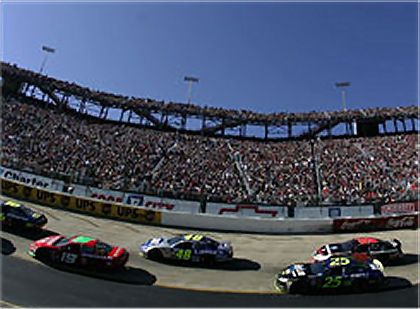
F1 is a sport that is being tugged in many different directions but the most important for the future is this battle between entertainment and sport. To see the future if entertainment were to win, one has only to glance at NASCAR. Have a look at Keith's poll on the subject (inevitably dominated by F1 fans since it is conducted on a F1 site) and read the comments. You will be left with an impression of a form of motor racing that has sold its soul to television, that has given its all to ensure close racing and constant overtaking, those two factors most often cited as what is missing from F1. NASCAR is the motor sport of the people and has its reward in the ratings. The model is there for F1 to follow.
But is that really what we want?