
Keith Collantine has written an excellent article on the unwritten rules of F1. He includes an occasion previous to Hamilton's penalty at Spa where the stewards "clarified" a rule after the event - de la Rosa/Schumacher at Hungary in 2006.
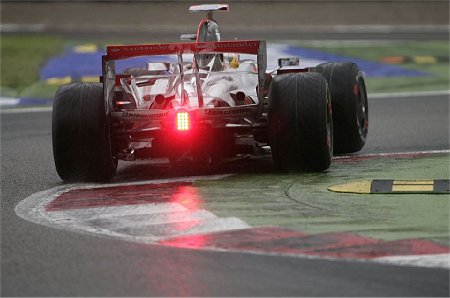
Lewis Hamilton in the Monza GP
It is quite clear that the stewards will interpret a rule in any way they want and then add to the existing rule to justify whatever action (or lack of it) they have taken. In effect, this amounts to applying rules in retrospect and penalizing drivers for rules that were not in existence at the time the alleged offense was committed.
That is not a healthy situation for the sport and is bound to lead to accusations of bias on the part of the stewards. If the unwritten rules are as easily defined as Keith has done, I can see no reason why they should not be added to the sporting regulations so that everyone knows what is and is not legal. One is tempted to suppose that they are not written so that the stewards can continue to affect the results of races (and therefore the championship) as they please. It is much harder to argue that a driver should wait a corner after giving back an advantage if that is not included in a written rule.
There is much that needs to be clarified if the stewards are going to hand out penalties in terms of section 30.3(a) of the sporting regulations. If it is illegal to depart from the track during a race, we need some sort of definition of what constitutes the track and what does not. The recent GP at Monza gives numerous examples of cars leaving the track and yet not being penalized for it.
The second section of the Variante della Roggia, the second chicane, was cut consistently by all competitors throughout the race. The plain fact is that it has to be cut if a decent lap time is to be attained. But that should not affect our view of the regulation - if the white lines edging the tarmac surface of the track are taken as the boundary of the track, all cars offended against the rule. This leaves us with the problem of defining exactly what amounts to cutting the chicane; where do we draw the boundary and say that, outside this line, you are cutting?
It seems to me that the most obvious and fairest route is to use the white line as the threshold between track and outfield. The kerbs are there for safety purposes and to give the drivers some leeway in cornering - they are not intended to be a method of straightening a corner that has been designed to be a part of the track. In my humble opinion, therefore, the rule should be that having all four wheels outside the white line amounts to leaving the track.
We can say that this is impractical in the case of della Roggia since, by my definition, all cars left the track in the second section, but that is a fault in the design of the chicane, not my rule. Like many chicanes, della Roggia is far too sharp for modern F1 cars and would slow the racing to a ridiculous extent if taken by the book. The answer is to ease the worst chicanes so that they can be taken at something approximating racing speeds, rather than forcing the cars to come almost to a stop.
The arguments over Massa's overtaking move on Rosberg show very clearly why a definition is needed. I happen to think that Massa did cut the chicane to complete the pass on Rosberg but many do not. If "leaving the track" were precisely defined as I have suggested, there would be no argument - a quick look at the video would be enough to see whether any of his four wheels had been outside the line and that would give us an answer.
To my mind, it seems that, before we can thrash out some sensible written rules on what should happen in the event of chicane cutting, we should define exactly what we mean by cutting. The recent events in Spa have highlighted just how devoid of rules F1 is in this area and there seems no reason why rules should not be written into the book to cover all foreseeable circumstances. When borderline cases occur, clarifications can be added, but not with prior effect - as we have seen, that leads to suspicion of bias on the part of the officials.
I have often written in this blog to the effect that the rules need simplifying rather than more complication. That was in relation to the technical regulations, however - somehow a rule that states only that the race shall take place on the track seems an over-simplification to me, especially when it is enforced apparently randomly and is subject to the opinion of those judging the issue. To me, the existing conventions for racing etiquette look far too much in favor of the driver in front, especially in a sport that is crying out for more overtaking, but to have them written into the rulebook would at least be a start in the task of ensuring fairness for all. They can be amended as and when we find ways to improve them.
But, with unwritten rules subject to interpretation at the whim of the stewards, there are bound to be controversies forever. Bernie Ecclestone may consider that good for publicity but there is no way it is good for the sport. Let the FIA get writing.