
I am rescued from having to write of Max Mosley's latest statement by Patrick Head giving his opinion on the Cosworth engine. The engine was last used in F1 by the Williams team and so he should know what he is talking about. And he does not agree that allowing the Cosworth to rev to 20,000 while the others have to stick to the current limit of 18,000 rpm will give it an unfair advantage.
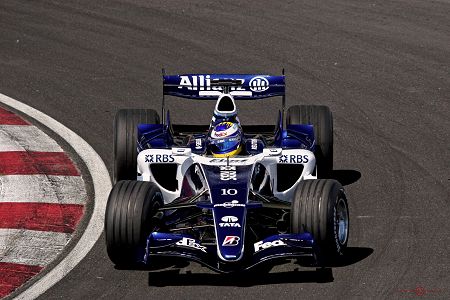
Williams FW28 of 2006 - the last Cosworth-powered car
A little thought should answer any doubts of the 2006 vintage Cosworth being competitive with next year's engines. Normally, one would expect that three years of engine development in F1 would have quickly rendered the Cosworth obsolete but that argument ignores the engine freeze instituted in 2008. Theoretically at least, this means that engines have received no development for much of the time that Cosworth has been away. There have been a few changes, it is true, but these were supposed to have been made in the interests of reliability; we can guess that such adjustments have increased power only slightly (although Ferrari's tweaks seem to have adversely affected the reliability of its engine - strange that).
Against this we should set the fact that the Cosworth was the first to get into the 20,000 rpm range and is no slouch, therefore. Bearing that in mind, it is reasonable to expect that the old lump would produce about as much power as today's F1 engines limited to 18,000 rpm, perhaps even a little more. Those who fear for the Cosworth's reliability in view of its higher revs should remember that it was reliable in 2006 and there is no reason why it should be any worse today.
I think it is reasonable that the Cosworth be allowed those extra 2,000 revs, therefore. Taking Patrick Head's points regarding its heavier fuel consumption and the additional weight that implies in a series no longer allowing refueling during races, there will be a slight disadvantage accruing to the Cosworth teams.
That fits rather nicely with history and tradition in the sport anyway. Customer engines were never as powerful as those run by factory teams and the old Cosworth DFV V8 was not able to equal the performance of Ferrari and Matra 12 cylinder engines, for instance. What made the difference for the teams using the Cosworth was its lesser weight and size that gave them more opportunity for playing with chassis design. And the result was a long string of Cosworth championships, as we all know.
That history is unlikely to be repeated with the re-entry of Cosworth to the sport. On balance, the advantages and disadvantages end up with the engine being a slightly less competitive proposition than others in the game. It is possible that innovation and excellence in chassis design can make up that difference but no more than that.
It is good that Cosworth is coming back, however. Aside from the nostalgia of those who remember the company's great achievements, it does mean that the range of engine choice is increased, thereby allowing F1 to maintain its variety, surely an important facet of the sport's appeal. Welcome back, Cossie!