
Over at Vee8, Doctor Vee has written a post about the proposed medal system for deciding the drivers championship - he is coming round to the idea. I still think that medals would put too much emphasis on winning races, rewarding the few who are in good cars that can win anywhere and obscuring the real heroes, the ones who drag uncompetitive cars into the points.
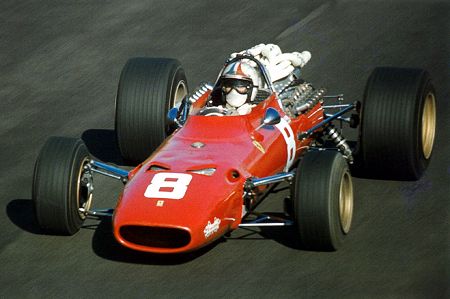
Chris Amon in the 1967 Ferrari 312
Naturally, I have had my say on the matter in the Doctor's comments system but F1 Wolf replied to me in a way that had me thinking. He said, "ultimately the championship is about winning, isn’t it?" Being as contrary as I am, I refuse to accept such a quick and easy definition of the F1 championship.
Obviously, every driver goes into each race hoping to win - as far as that goes, the Wolf is correct. But is that all that matters over the course of a whole season? I submit that there is far more to the sport than just coming first. History tells us that, in those years where a driver has more wins than anyone else, he has the best car; in such years, he is going to be champion whatever system is used.
But in the hard-fought, closely-run seasons, where there might be two or three good cars, it is often a driver with fewer race wins who becomes champion. The classic example is 1982, in which Keke Rosberg won his championship in a car that was nowhere near as competitive as others in the field. He won one GP that year, others won two - he earned his title by dogged determination and refusing ever to give up.
Do we really want to see the Kekes of the F1 world excluded from any chance of the championship merely because they do not have the best car? That is what the medal system will do, in effect; it is the major difference between medals and points that drivers of lesser machinery do not stand a snowball's chance in hell of becoming champion. As another instance, this year Robert Kubica would not have been anywhere near a shot at being champion under the medal system. Is that really just reward for his efforts? I think not.
As things are, Robert finished on the same number of points as Kimi Raikkonen, a man in one of the best cars of the year, and, until the last two races, it was mathematically possible for Robert to steal the title. His reputation has soared as a result and even Keith Collantine has him down as the best driver of the year. Yet is not the championship supposed to go to the best driver? At least the points system gave Robert an outside chance of being champion.
No, it is not just about winning - it is about being the best too. And I find my thoughts wandering through history to fasten upon one of my favorites of yesteryear: Chris Amon. Famous as being probably the best driver never to win a championship GP (he won non-championship ones), Chris stands as the perfect example of how winning is not everything.
It is generally forgotten that Chris Amon was the youngest driver to enter F1 when he started - he was a mere 19, the same age as Sebastian Vettel on his debut. His early years were blighted by uncompetitive cars and mechanical problems but the talent was obvious and he was taken on by Ferrari in 1967. Those were his best years, always competitive but stymied by unreliable cars whenever he was about to win. After the inevitable argument with the team, he left Ferrari and began a series of moves from one team to another, always at the wrong moment so that elusive GP win never came within reach.
It is his last year in F1 that I want to concentrate on in this discussion, however. Chris found himself in the tiny Ensign team driving a car that no one else had been able to lift beyond the midfield. It was a car built to the most basic formula of the time - aluminum monocogue chassis with Cosworth engine and Hewland gearbox, the standard approach for most new teams coming into F1. Midfield was all that the team could realistically hope for but that was reckoning without Chris. In his second race with it, the USGP West of 1976, Amon brought it home in 8th - good enough for a point today.
The next race was in Spain and Chris defied logic by claiming 5th place at the flag - two points even in those days. In the following races he suffered a series of mechanical retirements but his talent is obvious in his qualifying positions: 3rd in Sweden and 6th in Britain. Then came the Nurburgring and Niki Lauda's fiery accident. Chris did not take the restart, finally disillusioned with a sport that had claimed the lives of so many of his friends.
That last year in F1 had shown just how good Chris was, however. To take as primitive a design as the Ensign and compete with the advanced cars of Ferrari, Lotus, Brabham and McLaren was a feat worthy of a champion - yet this was done by a man who never won a GP. He is long retired but his name is still remembered - even now we wonder if a clearly talented driver who has missed out on winning is another Chris Amon.
Would he be remembered if winning were everything? No - the truth is that F1 belongs to all the competitors, from tail end Charlie to the man on pole, it is the struggle from year to year to get to the front, it is as much perseverance as it is cruising home in a superior car. Usually it will be the best car that brings in a new champion; but, just occasionally under the points system, someone will steal the spoils through sheer ability, talent and grit. Let us not take away that chance by bringing in a system that crudely counts up the wins in a season; we can do better than that.