
Everyone must know by now that the Red Bull boys and Alonso beat the Brawns to the front of the grid in Shanghai, so there would be little point in my adding to the excitement and surprise. It was a great qualifying result for F1, casting doubt upon the alleged advantage of double diffusers, mixing up the pecking order and suggesting a race of roller coaster fortunes in prospect. Add the fuel weights and tire selections to the recipe and it becomes a bit more predictable, however.
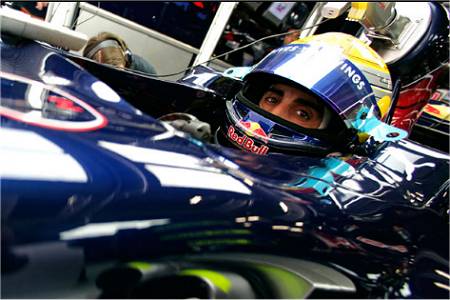
Latest Toro Rosso wonder boy, Sebastian Buemi
Keith Collantine has the weights and predicted first stint laps set out neatly and they confirm that Vettel, Alonso and Webber set their times with very little fuel on board. Fernando especially is gambling on being light at the start and could be stopping as early as lap nine. The strategy is fairly obvious; stick the super softs on for the first stint and go like mad in an attempt to build a lead in those early laps.
It is not a bad plan for the Red Bull team - the consensus is that the RB5 is the second best car at the moment and their best hope is to adopt a different strategy from the rest, aiming to be strong at the end of the race when the Brawns are weakest. But for Alonso it is optimistic at best. Such an early first pit stop will put him back amongst the midfield runners where, without KERS, he is bound to be held up while the Brawns and Red Bulls increase their lead. The Renault is not good on the medium tires and heavier fuel so he will struggle to remain in the points.
My guess is that the Red Bull strategy will fail to beat the Brawns as well. Both Barrichello and Button have enough fuel to stay out five or six laps longer than the Red Bulls, laps in which the Brawns can put in some very quick times as their fuel loads become lighter. And any gap that the leaders can build on Rubens and Jenson is unlikely to be very large - the BGP 001 is quite capable of keeping the gap down, even though heavier.
So I see the first five cars on the grid forming a tight bunch until the first pit stops and the Brawns hitting the front and staying there for the rest of the race. And the man to upset that prediction is Jarno Trulli. He is right with the Brawns on a similar but slightly higher fuel load and so is likely to stay with the leading pack in the opening laps. If he can put in a quick lap when the Brawns go in and if Toyota can do a faultless stop, he has a chance of emerging in the lead. And if he can do that, he just might give Toyota their first win; we have all heard of the Trulli train, haven't we?
Those are big "ifs", however. The sensible money has to be on one of the Brawns - but which one? Most commentators are going for Barrichello this time, so I might as well be different and say Button. It could go either way, however.
Lower down the grid there are a few minor surprises as well. Nico Rosberg looks to be in trouble with a fuel load almost as light as the Red Bulls'; I doubt that he will be able to stay with the leaders and will fade away as the race progresses. Raikkonen and Hamilton are both heavy and could pick up places through clever strategy. The same goes for Buemi and Heidfeld, although they need rain if they are going to get amongst the leaders.
Otherwise it is business as usual until we reach the unlucky guys at the back. Both Kubica and Glock are very light, obviously hoping to make up a lot of places from the start, and Sutil too is so light that he could be coming through the field at first.
That is how the race ought to go; reality is the great inscrutable, however, and I am sure that some of these guesses will prove to be wrong in the event. A few bad starts by fancied runners and everything could be reshuffled. But note how important the publication of fuel weights has become - without them, it would be a much harder race to predict.
In fact, I find the FIA's decision to publish the weights quite strange. To fanatics like myself, it is great to pore over them, comparing them with qualifying performance and building a picture of how the race will develop. But since when did the FIA give a monkey's fart for the fanatics of the F1 world? Their concern is much more for "the show" as it is presented to the casual fan, most of their efforts being concentrated on drawing in new viewers (not that I am saying they go the right way about it). And those fans are not going to be interested in extrapolating race performance from a list of car weights.
So why has the FIA done this? I can think of no other reason than it being part of the "openness" that the FIA has committed itself to. It hurts them not at all to release data that the teams would probably prefer to keep to themselves and it helps with the appearance of freedom of information. I say "appearance" because the FIA is not so eager to release facts that reflect directly on its own processes.
Ask for a transcript of a stewards' meeting, for instance, and you will be told that none exists. It has only recently emerged that Toyota offered to provide more evidence in their defense against being penalized in the Melbourne meeting but the stewards were not interested. I suppose I must just shrug and accept that such a lack of interest led to the present "lie-gate" fiasco.
And why was nothing released concerning Vettel's penalty in Australia? It was just as contentious an issue as the Trulli/Hamilton thing, yet we have no explanation whatsoever. One is forced to the conclusion that "openness" in the FIA means releasing only those facts that do not reflect badly on the processes of the sport's government.
Sure, we'll tell you everything you want to know about the teams; but reasoning behind a particular penalty? Oh no, that would not be a good idea. I can tell you what McLaren did wrong, however...