
Writing a blog about F1 has taught me a lot about the sport and the fans that follow it. One of the more obvious things that I have noticed is that each of us tends to see the state of the sport when we first started following it as the the golden age of F1, the time when everything was just right. Everything after that is viewed as a degeneration of the perfection that we once knew.
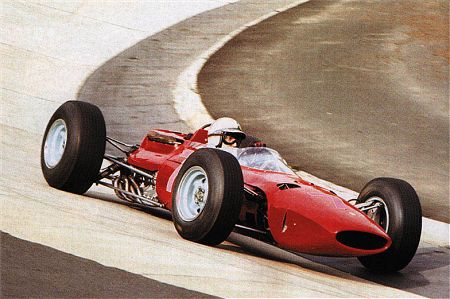
John Surtees in a "real" Ferrari, Nurburgring, 1964
Because I started watching the sport in the early sixties, right at the beginning of the brief 1.5 liter formula, those tiny tubes of metal with a screaming little engine at the back and narrow tires at each corner still look like "real" racing cars to me and the drivers assume heroic proportions, their various merits still to be argued over wherever old farts congregate. At the time, the older enthusiasts looked down (figuratively and literally!) on those miniature cars, considering that the big bangers of the fifties or even the thirties were the epitome of racing. But I loved the very smallness of those cars and engines, looking on them as works of fine art in comparison to the brutal giants of yesteryear.
For me, the rot set in when they increased the allowed engine capacity to 3 liters. And, when the designers started to put wings on the cars, my disgust knew no bounds.
Yet, for anyone who was introduced to the sport during the seventies, wings and big engines seemed the very essence of the sport and I am sure that Renault's re-introduction of the screamer, this time with a big turbo bolted on, must have seemed sheer sacrilege to such fans. In the eighties the turbo engines became the norm, of course, and fans entering in this decade no doubt look back on their outrageous power output as the high point of F1. Much mourning ensued when they were consigned to the bin and it became necessary to have a V-10 (of all things) to get anywhere in the races. Even these are viewed nostalgically by those who discovered F1 in the nineties and early noughties, the mandatory V-8s now being despised in their turn.
The apparent turn around in F1 regulations that has begun this year has met with general approval and I am sure that "golden age" nostalgia has a lot to do with that. Anything that helps the sport to go back to the good old days has to be a change for the better, we think. But, if the trend continues, we may find that our opinions on how far back into the past we should go vary considerably.
We can see this happening already with the fuss over the banning of tire warmers. Those who remember a time before the "blankets" are all for the change, considering them an unnecessary aid to drivers who should be able to warm their tires on the track. But for later joiners, concerns about safety arise and terrible thoughts of huge speed differentials occur.
To an old fart like myself, the temptation must be to scoff at such fears, pointing back to the days when drivers were gods and coped with such things as cold tires without a second thought. Yet we have to be grateful for small mercies and so we hold our tongues and give lip service to political correctness, tutting with everyone else over the latest affront to the great god safety.
Clearly, there will be disagreements amongst ourselves if the march back in time continues. Just how far back are we going? Having decided that all the work on aerodynamics of the last 25 years has ruined the racing, how much of the car should we outlaw? I have suggested getting rid of wings as a quick and easy means of booting out the aero boys, but that is altogether too radical a proposal for the vast majority of fans. So where do we stop, where draw the line?
The answer is, of course, that we do not know. It may feel that we are turning the clock back but the truth is that the future is always an unknown country. As fast as we re-introduce old ideas in one area, someone will invent something entirely new in another. Never will we see the cars of the past reborn into a brave new tomorrow; they stand as examples of their time and we can borrow from them but never return. We might look back with nostalgia to our golden age but we should admit that a new renaissance awaits us in each decade.
Good grief, I'm getting all poetic here. And all I really wanted to say is that, instead of getting into such a flap over each reversion to the past, let's just try it and see. If it really turns out to be an awful mistake, we can always change back again.