
I can't help it - I do love a good Mosley bash. And F1 Fanatic has a great post at the moment that majors on Max's love of reading F1 blogs. If you haven't given him a good thumping recently, hurry on over and score a few hits.
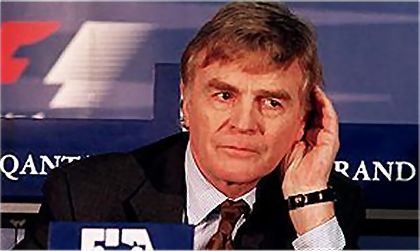
Max pretending to listen
It is Autosport that supplies me with ammunition this morning, however. In an article entitled Toyota engine chief says KERS 'primitive', Luca Marmorini explains why he feels that the FIA have not gone far enough with their intended implementation of KERS (Kinetic Energy Recovery Systems) into F1. In comparison with KERS already existing in production cars, the system chosen by the FIA is out of date, apparently.
Now, I am no engineer and I do not pretend to understand the latest advances in such things - but I am prepared to listen when someone with the expertise and standing of Toyota's engine chief gives his opinion. And, knowing that Max is a lawyer and not an engineer, I feel it is fair to say that he, too, should be listening to those who actually know what they are talking about.
Whether Max likes it or not, F1 has to be about engineering advance or it loses its claim to be the pinnacle of motor sport. If it is to be governed by someone who is not an expert in the myriad disciplines that go into the creation of F1, that person should listen very carefully to those who are at the cutting edge of such specialties. The problem is that Max gives the impression of listening to no-one, preferring to press on with his own agenda, whatever that may be. To summarily dismiss the proposals of the manufacturer teams for future regulations and instead institute a freeze on engine development looks like petulance, rather than a sensible route to the future.
Bernie Ecclestone defined the FIA's apparent approach to the government of F1 recently in his famous remark about his dislike of democracy. Bearing in mind that he said this as part of a tongue-in-cheek interview, it comes very close to expressing both Max's and Bernie's style of leadership. It may be that he has done F1 a service in that it focuses our minds upon the way the sport is governed.
In the comments to F1 Fanatic's post, Steven Roy summed up Max's achievements to date as getting rid of Balestre - and that reveals perhaps the greatest weakness of the FIA's structure: the presidents tend to stay too long and are almost impossible to remove, even when they are doing a patently bad job. It is becoming very clear that Max is not the real problem; the fault lies in the structure of the FIA. Even if Max were not to stand for re-election in 2009, the likelihood is that the FIA delegates would choose someone equally inappropriate to succeed him. They do not have a good track record, after all, and have repeatedly demonstrated an abject subservience to the president.
How the FIA can ever be re-structured I do not know. It is an organization that has proved extremely resistant to pressures from outside and it has weathered repeated threats to establish competing series to F1. But, if F1 is to survive as the pinnacle of motor sport in the future, it is imperative that some means be found to change the way in which it is governed.
When a man such as Mauro Forghieri says that he no longer watches F1 because of the restrictions placed upon it, there has to be something wrong.
Max pretending to listen
It is Autosport that supplies me with ammunition this morning, however. In an article entitled Toyota engine chief says KERS 'primitive', Luca Marmorini explains why he feels that the FIA have not gone far enough with their intended implementation of KERS (Kinetic Energy Recovery Systems) into F1. In comparison with KERS already existing in production cars, the system chosen by the FIA is out of date, apparently.
Now, I am no engineer and I do not pretend to understand the latest advances in such things - but I am prepared to listen when someone with the expertise and standing of Toyota's engine chief gives his opinion. And, knowing that Max is a lawyer and not an engineer, I feel it is fair to say that he, too, should be listening to those who actually know what they are talking about.
Whether Max likes it or not, F1 has to be about engineering advance or it loses its claim to be the pinnacle of motor sport. If it is to be governed by someone who is not an expert in the myriad disciplines that go into the creation of F1, that person should listen very carefully to those who are at the cutting edge of such specialties. The problem is that Max gives the impression of listening to no-one, preferring to press on with his own agenda, whatever that may be. To summarily dismiss the proposals of the manufacturer teams for future regulations and instead institute a freeze on engine development looks like petulance, rather than a sensible route to the future.
Bernie Ecclestone defined the FIA's apparent approach to the government of F1 recently in his famous remark about his dislike of democracy. Bearing in mind that he said this as part of a tongue-in-cheek interview, it comes very close to expressing both Max's and Bernie's style of leadership. It may be that he has done F1 a service in that it focuses our minds upon the way the sport is governed.
In the comments to F1 Fanatic's post, Steven Roy summed up Max's achievements to date as getting rid of Balestre - and that reveals perhaps the greatest weakness of the FIA's structure: the presidents tend to stay too long and are almost impossible to remove, even when they are doing a patently bad job. It is becoming very clear that Max is not the real problem; the fault lies in the structure of the FIA. Even if Max were not to stand for re-election in 2009, the likelihood is that the FIA delegates would choose someone equally inappropriate to succeed him. They do not have a good track record, after all, and have repeatedly demonstrated an abject subservience to the president.
How the FIA can ever be re-structured I do not know. It is an organization that has proved extremely resistant to pressures from outside and it has weathered repeated threats to establish competing series to F1. But, if F1 is to survive as the pinnacle of motor sport in the future, it is imperative that some means be found to change the way in which it is governed.
When a man such as Mauro Forghieri says that he no longer watches F1 because of the restrictions placed upon it, there has to be something wrong.