
Formula1Sport reports today that the European Union (EU) wants F1 to become a lot cleaner in its energy use and that the FIA are happy with that suggestion. "Malcolm" has replied with a comment so pertinent that I copy it here:
Here’s an idea: mandate 10 or 15 mpg (really high for a racing engine; they’re usually around 4-5), and some other equivalent if hydrogen is used, and then have no engine rules beyond that. That’ll produce green engines… you’ll see lots of diversity (hybrids, hydrogen, etc, etc).
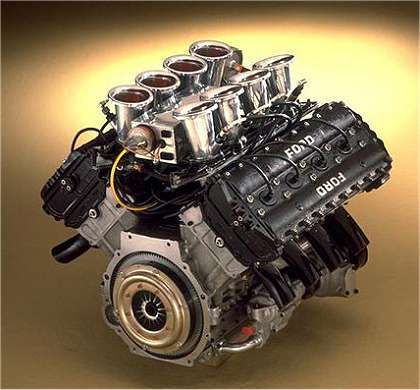
Cosworth DFV V8
Now that is what I'm talking about. I am guilty of occasionally writing a post attacking Max's supposedly green measures for F1 and that might give the impression that I am an old dinosaur unaware of the damage we do to the planet. That is not so, in fact - I am well aware that we need to be researching alternative forms of energy, if for no other reason than fossil fuels will run out sooner or later. What does annoy me is the "CO2 emissions cause global warming" nonsense, since it has been proved repeatedly that worldwide CO2 levels increase after global warming, not before it. The whole carbon offset industry is based on a false premise, therefore, and I fail to see why F1 should go along with it.
But alternative fuels must be developed and Malcolm's comment shows the way for F1 to be a major force in our research into what is possible. He has also pointed out that this gives us an opportunity to free the engineers from the stultifying restraints put on them in recent years, thereby allowing their creativity and invention to flourish once again.
What is happening in F1 now is strangely similar to the events of the sixties. In 1961, the engines were restricted to 1.5 liters unsupercharged in an effort to limit the speeds the cars were attaining (does that sound familiar?). As it happened, the attempt was unsuccessful and speeds continued to rise, mainly thanks to the rear-engined and monocoque chassis revolutions that were happening at the same time.
Aware that the small engines had failed in their quest and had the disadvantage of being less dramatic than larger ones, the governing body changed the rules in 1966 to allow for 3 liter engines (or supercharged 1.5 liters). A mad scramble for suitable engines resulted and some very odd and very ineffective solutions were tried before the Cosworth DFV made its debut.
It is a fascinating period for the F1 enthusiast, a time of experiment and innovation, a time when, if you hit on the right answer, you shot to the front, if you tried something less effective, you could find yourself at the tail end of the field. Cooper went with a big and heavy Maserati V12 and never returned to their glory days as a result; Lotus introduced the Cosworth V8 and went from triumph to triumph from there onwards. And BRM produced the H16, a fiendishly complex monster that produced plenty of power but invariably went bang in short order; this too heralded their ultimate demise.
Funnily enough, it was the Repco-Brabham V8 that dominated to begin with. This was based on an existing Australian engine which, although not enormously powerful, had the virtue of being reliable, thereby allowing the Brabham cars to win two quick championships while the others were still finding out how to make their solutions last a race.
It was a period of great diversity and ingenuity, demonstrating how interesting things can get when restraints are lifted. And what better cause to lift restraints than in the service of the green revolution? There are workable alternative fuel sources available already, but the manufacturers are slow in developing and refining them; the most advanced to date is the hybrid car, which is more of a cosmetic thing than a real advance, since it uses the same amount of gas as any other car.
Formula 1 could be the leader in turning the possiblities into realities. The will to win is such that, given Malcolm's formula, the engineers would find ways to make things work. In a very short time it would become clear which was the most efficient and workable solution and the manufacturers could concentrate their energies on developing that, rather than a horde of other suggestions.
It is a radical idea but, if we really believe that F1 must move with the times and justify its existence, this is the way to go. Max's plan to have a few energy-reclaiming devices glued on to the same old gas guzzlers of the past is just not cutting the mustard at all. The EU may well have put an end to Max's engine freeze by their pronouncement - but will he have the courage to make the really radical changes that are necessary?
Here’s an idea: mandate 10 or 15 mpg (really high for a racing engine; they’re usually around 4-5), and some other equivalent if hydrogen is used, and then have no engine rules beyond that. That’ll produce green engines… you’ll see lots of diversity (hybrids, hydrogen, etc, etc).
Cosworth DFV V8
Now that is what I'm talking about. I am guilty of occasionally writing a post attacking Max's supposedly green measures for F1 and that might give the impression that I am an old dinosaur unaware of the damage we do to the planet. That is not so, in fact - I am well aware that we need to be researching alternative forms of energy, if for no other reason than fossil fuels will run out sooner or later. What does annoy me is the "CO2 emissions cause global warming" nonsense, since it has been proved repeatedly that worldwide CO2 levels increase after global warming, not before it. The whole carbon offset industry is based on a false premise, therefore, and I fail to see why F1 should go along with it.
But alternative fuels must be developed and Malcolm's comment shows the way for F1 to be a major force in our research into what is possible. He has also pointed out that this gives us an opportunity to free the engineers from the stultifying restraints put on them in recent years, thereby allowing their creativity and invention to flourish once again.
What is happening in F1 now is strangely similar to the events of the sixties. In 1961, the engines were restricted to 1.5 liters unsupercharged in an effort to limit the speeds the cars were attaining (does that sound familiar?). As it happened, the attempt was unsuccessful and speeds continued to rise, mainly thanks to the rear-engined and monocoque chassis revolutions that were happening at the same time.
Aware that the small engines had failed in their quest and had the disadvantage of being less dramatic than larger ones, the governing body changed the rules in 1966 to allow for 3 liter engines (or supercharged 1.5 liters). A mad scramble for suitable engines resulted and some very odd and very ineffective solutions were tried before the Cosworth DFV made its debut.
It is a fascinating period for the F1 enthusiast, a time of experiment and innovation, a time when, if you hit on the right answer, you shot to the front, if you tried something less effective, you could find yourself at the tail end of the field. Cooper went with a big and heavy Maserati V12 and never returned to their glory days as a result; Lotus introduced the Cosworth V8 and went from triumph to triumph from there onwards. And BRM produced the H16, a fiendishly complex monster that produced plenty of power but invariably went bang in short order; this too heralded their ultimate demise.
Funnily enough, it was the Repco-Brabham V8 that dominated to begin with. This was based on an existing Australian engine which, although not enormously powerful, had the virtue of being reliable, thereby allowing the Brabham cars to win two quick championships while the others were still finding out how to make their solutions last a race.
It was a period of great diversity and ingenuity, demonstrating how interesting things can get when restraints are lifted. And what better cause to lift restraints than in the service of the green revolution? There are workable alternative fuel sources available already, but the manufacturers are slow in developing and refining them; the most advanced to date is the hybrid car, which is more of a cosmetic thing than a real advance, since it uses the same amount of gas as any other car.
Formula 1 could be the leader in turning the possiblities into realities. The will to win is such that, given Malcolm's formula, the engineers would find ways to make things work. In a very short time it would become clear which was the most efficient and workable solution and the manufacturers could concentrate their energies on developing that, rather than a horde of other suggestions.
It is a radical idea but, if we really believe that F1 must move with the times and justify its existence, this is the way to go. Max's plan to have a few energy-reclaiming devices glued on to the same old gas guzzlers of the past is just not cutting the mustard at all. The EU may well have put an end to Max's engine freeze by their pronouncement - but will he have the courage to make the really radical changes that are necessary?