
Alan Donnelly has been attempting to justify the FIA stewards' atrocious decisions this season; Doctor Vee posted a very good article this morning that explains why Donnelly's sole example to counter the accusations of bias is actually yet further evidence of the FIA's unwillingness to penalize Ferrari in terms of their own regulations.
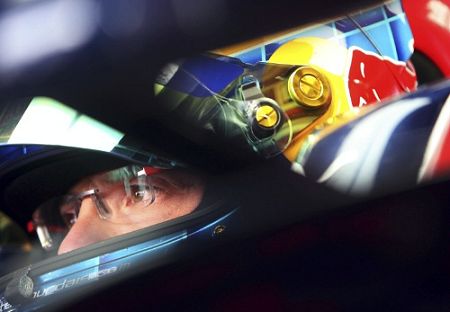
Sebastien Bourdais
But there is much more in Donnelly's argument that needs to be challenged. In fact, the whole statement is full of misleading information, self contradictory logic and plain lies. And he starts with that favorite tactic of his mentor, Max Mosley - the insult of anyone who dares to disagree with the FIA:
I read so much rubbish on the decisions taken by the stewards this year. They write that the FIA and the stewards are always favouring Ferrari, and that we don't want Hamilton to become world champion.
It seems to me that Mr Donnelly should prove that this is rubbish before declaring it so. He does go on to expand upon his point but merely to reiterate what we know to be the view of the FIA is not proving anything. As I have mentioned, Dr Vee has already shown that Raikkonen's penalty in Monaco was just another example of pro-Ferrari bias, the statutory penalty for that particular offense being to start from the back of the grid, not a drive-through penalty.
He then goes on to look at Hamilton's penalty for the first corner incident in Fuji. "But at that speed he could never do the turn," says Donnelly, ignoring the fact that Hamilton nearly did make the turn and used only the edge of the run off area, as so many others have done at the first corner ever since tarmac run offs became the norm.
It is his next statement that is really the biggest nonsense of all, however. He says that, "by going off he could have caused a much worse accident." Ummm, Mr Donnelly, he did go off and there was no accident; by the time the McLaren left the track, it was so far ahead of the other cars that it was impossible for it to cause anything. The fact that others were also going wide into the corner had nothing to do with Hamilton; they merely found that cold tires at Fuji tend to make it difficult to turn in at the first corner, just as Hamilton did.
As for the FIA's responsibility being to "make the drivers have a safe and honest behaviour", I would suggest that they should have applied that to Massa's pit stop in Valencia by imposing the penalty for dangerous release into the pit lane as per the regulations.
Then he moves on to the suggestion that a former racer should assist in the stewards' decision-making process and now the argument becomes truly absurd.
I don't feel that is the correct solution, because their experience is tied to the past, from when they used to drive. And since then, let's say ten years ago, racing has changed.
No, Mr Donnelly, the racing has not changed; driving techniques remain very much the same and what applied ten years ago is still a guiding principle today. What has changed is the desire of the FIA to push their own agenda upon the competition by interfering whenever there is an opportunity to take points from other teams and give them to Ferrari.
He negates his own argument a bit later on, as it happens:
We have stewards who have done this job for 20-25 years, when some of these drivers weren't even born yet.
If drivers from ten years back have no relevant experience in modern racing, how can it be said that old stewards have anything at all to bring to the process? It is a lie, anyway, many of the appointed stewards never having watched a F1 race before. That is how much understanding of racing the FIA requires from their stewards and it is inevitable that fans will think stewards are merely there to rubber stamp the recommendations of Mr Donnelly himself.
Then out come the statistics and they are much more revealing than Mr Donnelly expected. He said:
In 16 races 69 penalties have been inflicted: 35 originated from the changing of engines, gearboxes, or going over the speed limit in the pit lane, and the other 34 came from incidents. I don't think that's a high percentage, also keeping in mind that we analyse tens more cases and we decide not to intervene.
Thirty-four penalties in sixteen races seems an awfully high percentage to me and confirms the general feeling that there has been far too much interference from the stewards this year. But I cannot let him get away with the assertion that the stewards analyse far more cases that are not penalized. Stewards' investigations are always announced and there have been precious few this season that have not resulted in penalties being handed out. If Mr Donnelly wants to make such vague assertions, I suggest he gives us figures to cover them.
Finally, we go on to another criticism of the stewards, the amount of time it takes for them to decide, particularly when a red car is involved. This is what Mr Donnelly has to say on the matter:
One of the complaints we used to receive in the past was that penalties were inflicted late. So we kept up with the times.
At Fuji we decided immediately that both Lewis and Massa had to be penalized. Other times, as was the case with Bourdais, we have to wait until after the race to talk to the drivers. But out decision are always well thought out.
I cannot see how better Mr Donnelly could illustrate the principle of one rule for Ferrari, another for the rest. The first corner incident was one of the most controversial decisions of the season but was decided in moments, it seems, without any need of hearing anyone else's point of view. But the Massa/Bourdais thing required that the stewards talk to the drivers. Why? Did they expect either of them to hold up his hand and admit to causing it? Have they never listened to drivers giving one-sided versions of an accident in which they are always completely blameless?
No, Mr Donnelly, you wanted to see the result of the race before deciding whether it would help Massa if Bourdais were penalized - that can be my only conclusion after your horrendous decision in Spa.
Unfortunately, the interviewer never asked Mr Donnelly just what qualifications he has for his position of "advising" the stewards. As far as we can see, he is there because he is one of Max Mosley's most trusted friends and can be relied upon to see things Max's way, therefore. He has so little connection with motor racing that it is hard to see why else he should have been chosen for such a position. And, if he is to attempt to justify such obviously bad stewarding decisions in the future, he needs to get a much better story together - this one won't wash.