
I seem to be forming a habit of quoting Steven Roy but here goes anyway. In a recent comment on an article in F1 Fanatic, Steven made the following point:
"I think he [Allan McNish] also suffered by being the first high profile young test driver in F1. Until then drivers would have the occasional test with one or more teams and then either be signed to race or not but he was the first to have a contract as a full time test driver while in the junior formulae. I think this worked against him getting a full time drive. McLaren were happy with Senna and Berger and other teams saw McNish as a McLaren man who may drive for them short term but as soon as Ron came calling he would disappear off to Woking."
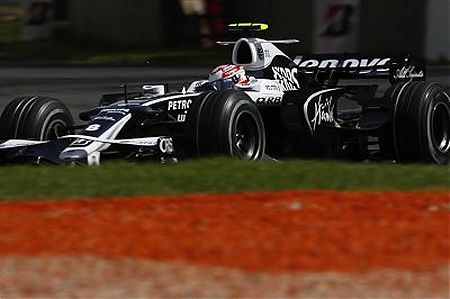
Kazuki Nakajima
That made me think. We have recently seen the disappearance of realistic test driver positions because of the limitations set on testing. Many have decried this move as it prevents young drivers from gaining a year's experience in F1 cars before actually entering the competition - and I admit that I happily went along with this notion until I read what Steven had to say.
It struck me then that test drivers may not be such a good idea after all. In previous years, test driving became almost the standard route for progression from lower formulae to F1 and many of the young stars of today served their apprenticeship as test drivers. Kovalainen, Kubica, Sutil, Glock, Vettel, Piquet and Davidson all spent time as test drivers before getting a race seat in the sport.
With more than half of that list proving very useful competitors (the jury remains out on the others), it would seem that the system worked pretty well. New drivers gained some experience in the car and with the team, and learned at least the rudiments of setting it up for good lap times. So far so good.
What happens if we look at those few rookies who went straight from a feeder series into a race seat, however? There are only three to be considered at the moment: Hamilton, Bourdais and Nakajima. And here it has to be admitted that they show no signs of suffering from such a huge leap into the big time.
I hardly need to list Hamilton's achievements in his F1 career so far - Steven considers him the best driver in the sport and, while I reserve final judgement on that, I am coming to the same opinion. But maybe Hamilton is special, that one in a million who could handle the promotion with apparent ease. What of the other two?
They are more difficult to assess, being in less competitive cars, but Sebastien Bourdais is not being put to shame by his much-hyped team mate, Vettel. Indeed, he has the better record so far. And Kazuki Nakajima has performed well above expectations, being reliable in the races, occasionally faster than his team mate, Nico Rosberg, and scoring points quite regularly.
Nakajima is perhaps the most interesting case, for the history book says he should be a good deal less useful than he is proving to be. Although he was a regular visitor to the podium in GP2, he never actually won a race and his seat at Williams was largely thanks to his being a Toyota protegé. Japanese drivers have a reputation for recklessness but Kazuki has had only one DNF so far, and that through no fault of his own. And he is steadily adding to his points score, surely a good sign for any newcomer.
Putting aside my Nakajima bias for a moment (before the season started, I tipped him as one to watch), it has to be said that none of the three who short-circuited the standard route seem to be suffering from that fact. If anything, it looks as if time spent as a test driver is actually a handicap; consider how Kovalainen struggled in his first few races and how Piquet does the same this year. Glock seems nothing to write home about, Vettel has yet to really impress and Davidson, who has more testing experience than the rest put together, never made his team mate, Sato, look stupid.
It may be coincidence but, on the evidence before us, it looks to me as though test driving was a very bad idea from the driver's point of view. Whatever the reason for that, it must be said that, for once, the FIA have instituted a good rule change, even if accidentally. And it goes to show that we should not be so quick to condemn change - sometimes reality proves all our theories wrong.