
F1 Fanatic has an article today on domination of one driver in F1 and NASCAR. As it always does, this develops in the comments into a comparison between the two forms of motor sport and I am led to muse once again on the future awaiting the collection of apparent self-contradictions that calls itself Formula One.
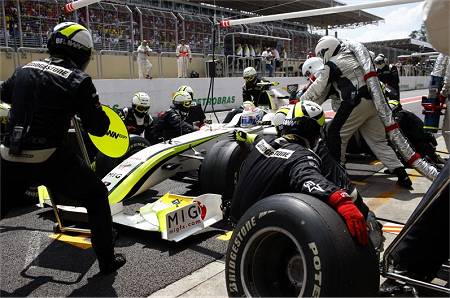
Teamwork
I think it is entirely coincidental that "the pinnacle of motor sport" has developed in such a way as to mix intentions and aims that appear to conflict with each other. The fact that there are two championships involved, the drivers' and the constructors', seemed logical at first but, increasingly, brings tremendous pressure upon the nature of the sport as manufacturers and teams assign importance to one or the other. Many of the team managers would like to see the constructors' prize elevated to a position above the drivers' award; the manufacturers especially are in the game to demonstrate the superiority of their product rather than the excellence of any particular driver.
To date, the tension between these two goals has remained in balance, mainly because a team needs a top level driver who can make full use of its car. That may be changing, however, as illustrated by the debate over the worthiness or otherwise of this year's champion, Jenson Button. The fact that some argue that he would not have been champion had not the Brawn BGP001 been so superior to the opposition devalues the drivers' championship and suggests that whoever is in the best car will inevitably win the prize.
This has been the case in F1 ever since the constructors' trophy was introduced. Many would question the worthiness of such drivers as Mario Andretti, who won his championship in the Lotus 79, a car that was light years ahead of the competition, and who was teamed with a driver, Ronnie Peterson, reputedly only allowed to win if something happened to Mario. Much the same can be said of Michael Schumacher's championships and doubt has been cast upon the value of Jacques Villeneuve's and Damon Hill's championships in view of the superiority of their cars. By that reasoning, those drivers who won in less than the best car (Keke Rosberg springs to mind) would be the only true champions.
Although this dichotomy of goals in the sport leads to endless debate and argument over the real worth of each driver, it is also the factor that sets F1 apart from other forms of motor racing. Were we only interested in which driver is the best, a spec series in which all cars are equal would be the logical way to go. As it is, the unfairness of F1's system of diverse designs provides us with the opportunity to see astounding feats performed by outrageously gifted drivers; Ayrton Senna's drives in 1993 and Alonso's efforts over the last couple of years are examples.
So this aspect of F1 is immensely important to its appeal for us, the fans, and the FIA's ludicrous efforts to equalize everything from engine power to wing design are contrary to the spirit of the sport, threatening to reduce the value of the constructors' award to meaninglessness. As yet, the balance of objectives survives but it will be destroyed if the rule makers continue in their chosen direction.
So why has the FIA begun this process of standardization? The answer lies in another conflict of aims within the sport: entertainment versus sport itself. And here the lines become blurred, confusing us to the extent that we may argue from one point of view in some debates and from another in others.
It seems important to me to establish what we are trying to achieve with F1 and, to do that, we need to examine its roots. Without an understanding of the reasons for the sport's attraction for so many millions (both fans and dollars!), we will never understand what needs to be preserved and what can be allowed to wither.
And the most important factor we should realize is that entertainment was not the reason for the formation of the sport in the first place. Motor racing has been around for over a hundred years now and it was always inevitable that, sooner or later, the idea of a world championship should be suggested. To win a race is a fine achievement in itself but to win a series of races over the course of a year establishes real superiority.
From which we can see that F1 was invented for the drivers originally, not for the constructors or any fanbase that might accumulate. As in any other sport, the intent was to formalize an existing competition so that a competitor could demonstrate that he was the best. The matter of whether the result would be interesting enough for those outside the sport to watch was never taken into consideration.
It is potentially the undoing of F1 that it is watchable and has the capacity for becoming an obsession for some. As the number of fans has grown over the years, the possibility of making money from the sport has become too obvious to be ignored and, indeed, has become so important to those who benefit the most from exploiting the game that the nature of F1 has been obscured. Even FOTA, the organization of those who should understand the sport more than any other group, spends much of its time proposing ways to improve the show.
In effect, F1 has sold its soul to those who want only to milk it mercilessly. It has harbored ambitions of being a business and is now suffering the consequences as the money men seek to make it pay even more. And, just as in the fairy tale, the danger is that they will kill the goose that laid the golden egg.
No doubt you have been wondering (I have, anyway) where NASCAR comes into all this. It is relevant because it is further along the road to entertainment than F1, allowing us to see what the future might hold. Its increasing interference in the course of races to ensure close finishes and plenty of action is echoed in the direction F1 has taken over the last few years; we may not yet be at the stage where spurious safety car periods are introduced to close up the field but it is coming if F1 does not change course.
We need to face the fact that the number of viewers is not the measure of F1's success. Its success is in the value of its championship, the demonstration that this or that car and driver are the best in the world. That is what matters and whether the "show" is watchable or not has no relevance to the sport (or any sport, come to think of it) at all. If it is attractive enough to be televised, that is icing on the cake and we should not allow greed to distort the sport in an effort to get more.
The fact is that F1 is eminently watchable without artificial introductions to make it more of a draw to the public. I have followed it for over forty years, from a time long before it was televised, and there are many more like me amongst its fans. The glory of the sport itself was all we ever needed and anything that detracts from this serves only to turn us away.
We are a dying breed, of course, and you would be entitled to say that we do not matter in a world where TV viewing figures are all that count. But we are the true fans, the ones who have stuck with it through the years and the rule changes, and there are many like us amongst the new fans. If we depart, F1 will indeed become an entertainment, subject to the passing fancy of the masses and a vehicle only for the making of fortunes by a few. Then you will have NASCAR without the wheels being covered...